

Blog 3: The journey to join the ancestors: Akan burial practices
I am fascinated by history, culture, archaeology and anthropology and I enjoy watching documentaries about the history of the planet and humans. One documentary I watched recently was about a new archaeological site in South Africa and how it was a remarkable discovery that early humans buried their family members who died. Perhaps it shows an emotional sophistication or intellectual development that separates humans from animals. I can’t say for sure, but it was a huge finding for these scientists to discover graves built by pre-humans. This goes to show a historical importance in burials. The way in which burials take place, however, vary widely depending on country, culture and religion. From building elaborate tombs to quick cremations, societal burials have been essentially modelled according to beliefs about the afterlife. In the third blog of these series, I want to present what I have learned about burial rituals about my ethnic tribe – the Ashanti/Akan people.
The Akan beliefs about the afterlife
The Akan people believe that deaths are transitions to an afterlife. The body dies but the soul lives on forever and are sometimes brought back into the world through reincarnation. An individual who has lived an exemplary life as an elder and dies will be transformed into an ancestor (Adu Gymafi et al, 2020). The spirit of such a person would travel to join the ancestors who live in the next life, locally called Asamando. My father informed me that some years ago, the Akan used to bury the dead after 40 days because it was believed that the soul wanders around for 40 days before it settles. This does not seem to be the practice anymore. But, I also found it fascinating when my Dad added that there is also some biblical importance attached to 40 days (e.g. Moses spent 40 days on Mount Sinai; God destroying the earth with rain for 40 days; and 40 days between Jesus’ resurrection and ascension).
Because of the importance of the afterlife, a “befitting” burial is required, according to Akan beliefs. The befitting burial is even more critical due to the belief that the ancestral spirits often decide on the fate of the living descendants.
The One Week Observation
Following the death of a person, a gathering is planned after one week for family members and friends. In our case, we rented a guest house that could host about 200 people in the garden. The place was decorated with posters of my mother and a DJ was hired for the music entertainment. Guests came in and out to sympathise and shake hands. All of us were dressed in traditional funeral clothes: black or black and red. Drinks and snacks were served. It was also at this event that the family had a meeting to decide where and when mum would be buried. The final decision lied with the maternal head of the family who is also a chief. While, my sister and I had preferred a burial in Accra, this was not permissible by the head of the family who to his credit, graciously explained why it’s important for my mother to be buried in her village. My sister and I who had never been to my mum’s village saw wisdom in the Chief’s advice for us to use this unfortunate occurrence to connect with our hometown. As an economist, I also appreciated when he said, the burial of my mum may even encourage us to think about the economic development of the village. He reminded us that we are not from Accra; we are Ashanti people.
The actual funeral date was set, and this was communicated to all the guests who came to the one week observation.
Burial weekend: Friday night mourning
Funerals take place on Saturdays but there are important rituals that take place on the Friday nights. On this day, the body is transferred from the morgue to the maternal family home and is washed and dressed for display on the following day. During this time, close family members gather and “keep wake” till early hours of the morning. Mourning music is played all night on loudspeakers. A few family members are normally called into a room to observe the bathing of the body. My older sister, my aunt and a couple of the other ladies joined this process. My sister was cautioned that crying during this process was not allowed and if she couldn’t handle it, then its best she let the aunties do it. My sister bravely did her duties. During this time, a small purse was discreetly tied to my mum’s body and my sister was asked to put some money in it. Again, it follows the idea that she is preparing to undertake a journey and must be equipped for that.
Burial Weekend: Saturday – The Main Event
For the close family, the day begins at 4am. We gathered at the family home and had a private viewing of the body before guests arrived. Mum was dressed in a sparkling white dress and laid on a bed in a decorated room with fresh flowers. This was the moment for crying and we wept but it was awkward for many reasons. One, my mother was not recognisable anymore. She had been in a morgue for 6 months at this point and was perhaps overly styled with false eyelashes to boot. Two, it was jarring to see how people switched from smiling and chatter to crying and wailing then back to chit chat… My sister and I couldn’t keep up with the performance and were perceived as “cold”. A queen mother in the family whispered to us that we (my sister and I) must be seen to be going into the room to view the body from time to time and openly weep. She said it’s important for guests to see the children mourning. We obliged as best as we could (minus the wailing part).
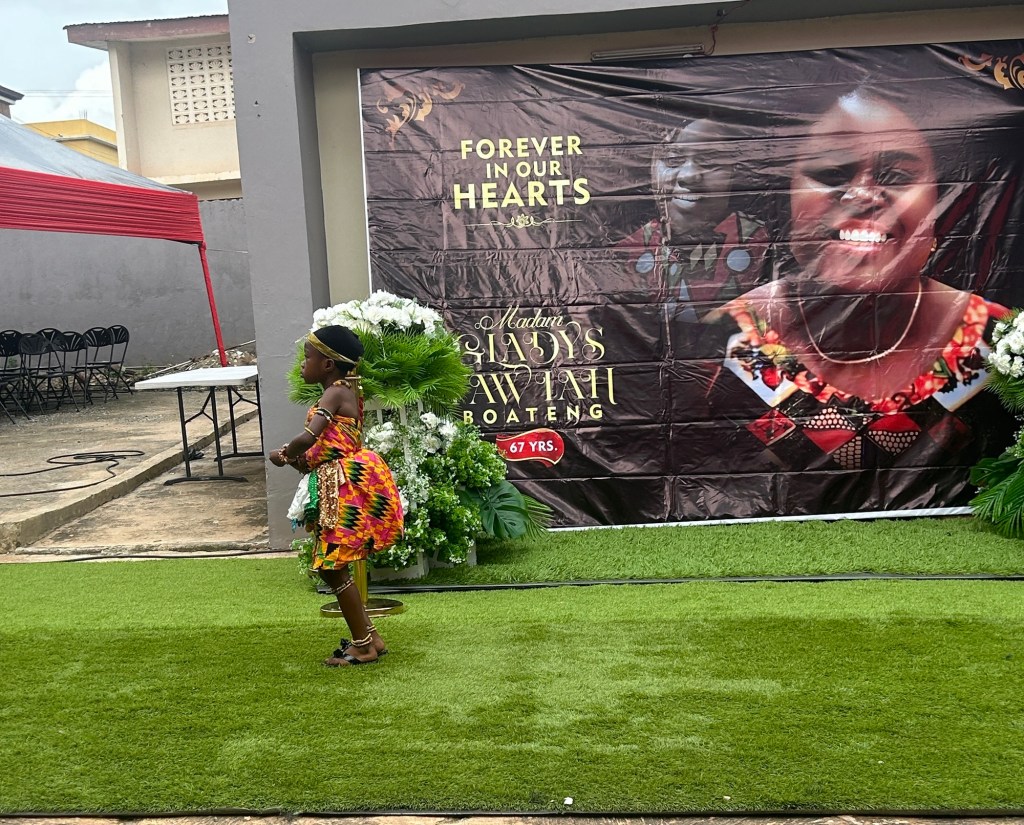
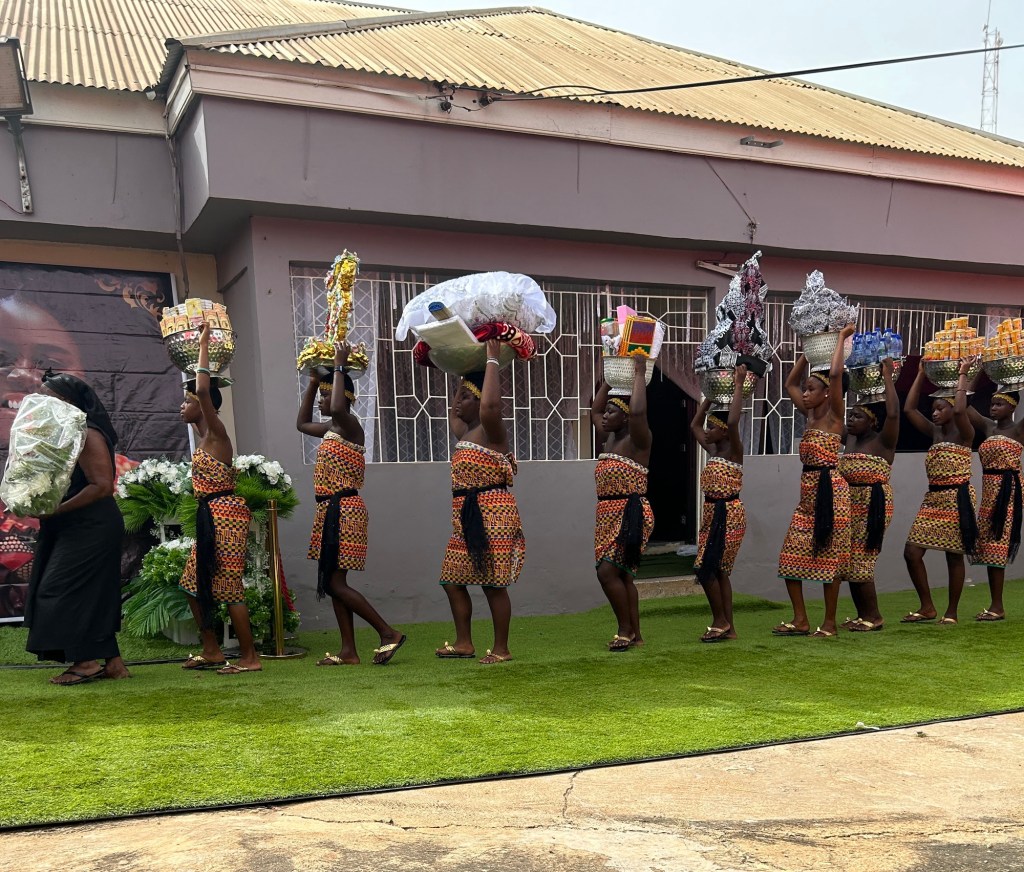
Akan funerals are successful if they are very well attended and if there is proper demonstration of utter devastation. It is for this reason that professional mourners (elderly women with skills to turn on the water works and roll on the floor) are sometimes hired to enhance the mood at the event. The morning session involved a lot of shaking hands, dancing and presentation of “gifts”. The gifts are a set of items purchased by the family to showcase the arrangements made to facilitate the journey to the afterlife. This is the only time I took pictures because I found this fascinating. Young girls dressed in traditional kente cloth carried the items in a basket on their heads. Each item was presented and explained to the audience by the MC of the event. It included large amounts of matchboxes, water, soft drinks, sweets, fabric, schnapps, and others. It was explained that my mother would not wander in the dark because she now had these matches to light her path; she would not thirst as we are sending her with water and soft drinks to hydrate her; she would have clothing; she would have a mat and some blankets for sleeping; sweets to energise her; etc.
When my mother was placed in the casket, some of these items were placed in it as well: sweets, drinks, cloth, a mat, blanket, etc. “Libation” was poured, and words were chanted at this point by the family head. Libation follows an Akan belief that spirits/ancestors can be summoned for help, but you have to present them first with alcohol to quench their throats before asking their support and acceptance of the person about to undertake the journey to join them.
Once the casket is taken outside, the tributes are read. My sister bravely read the tribute on behalf of the siblings. A church service was also held. The juxtaposition of Christianity and traditional beliefs in Akan burials would baffle anthropologists. A completely different message about the transition to heaven (as opposed to another world of ancestors) was preached and this wrapped up the morning of the Saturday.
Close family members proceed to accompany the casket to the funeral grounds where another short service is held. The ceremony is small and intimate and for the first time, I feel connected to what is happening in a genuine way. After the burial, the funeral continues in the family home. This necessitates a change of clothes. We proceed to make our third outfit change. (note: the first outfit was worn Friday night, and second was worn on Saturday morning). We dress in black and red for this part of the ceremony. Dress code is a very important part of Akan funerals. For example, a black outfit worn on the Friday cannot be worn again on the Saturday. A buffet lunch is served to guests now arriving in large numbers. Then it’s a time for “cash donations”. A process is that managed by a very experienced MC. Donations are publicly announced – it’s a very awkward process. This goes on all afternoon in between dance performances.
Sunday thanksgiving service
On Sunday, the family dresses in a white and black outfit for the thanksgiving church service. This is the 4thoutfit change. My mother was a member of the Church of Pentecost, so the family gathered there at a local branch where my mother’s passing was acknowledged. The afternoon session was held back at the family house with lunch and with a DJ playing music.
Monday debriefs and accounting
The family would typically gather on the next Monday to debrief and take stock of the accounting. Normally, family members contribute to the expenses and then recoup their costs through the donations. If there is still a debt, they will figure out how to raise additional funds for it. In our case, the money advanced by my sister and I plus donations received didn’t cover all the costs. There was intense discussion about how the remaining debt and ultimately, it was decided that my sister and I should fully cover the debt. We obliged. Normally, if there is a need to appoint a new head of the family (in case the deceased was a family head), it is done so at this meeting. Here, they informed us about who would stand in for us as our mother. I thought this was a beautiful custom.
Conclusion
Evidently, I have very mixed feelings about our traditional burial practices. On the one hand, I appreciate the preservation of culture and a practice that is uniquely African. On the other hand, it has a “showbiz” element to it that takes away from a genuine grieving process. It is common practice for Ghanaians to get into debt in order to host what is called a befitting funeral. I would wish for a compromise that honors tradition and leaves out the excesses.


 The Afro Optimist